Platform Modernization: A Four-Phase Roadmap for 2026
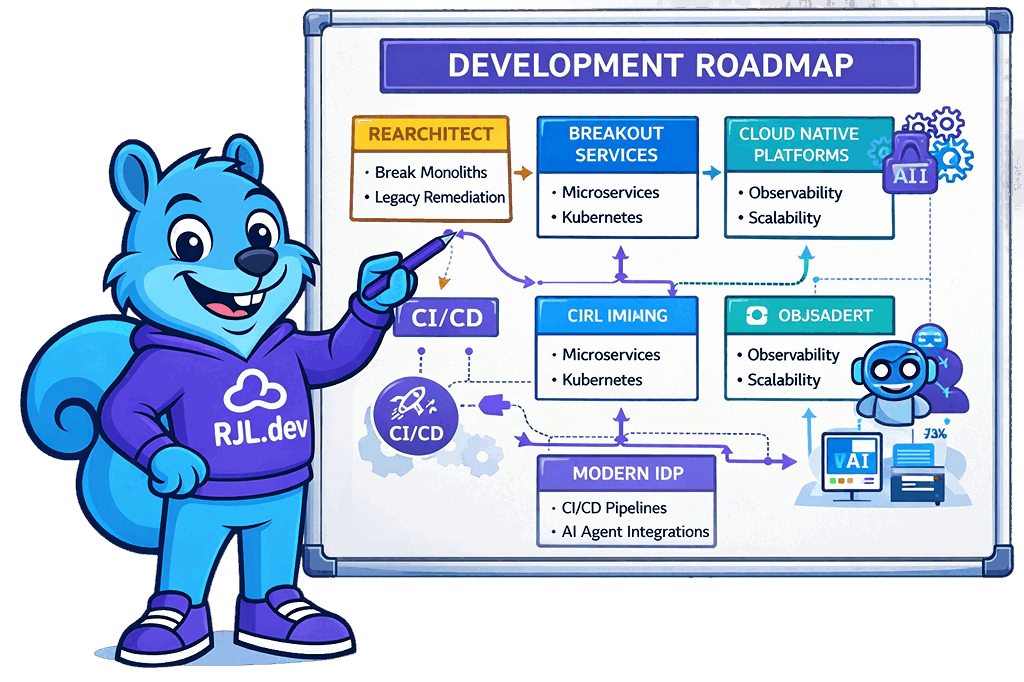
Platform modernization in 2026 is more than a cloud migration. A four-phase roadmap - assess, architect, migrate, operate - that retires 65% of technical debt, cuts release cycle time 40%, and stands up an internal developer platform built for agentic AI.
Platform modernization in 2026 is not a cloud migration project. The cloud move is table stakes - the durable win is the internal developer platform underneath it that makes every engineering initiative, including agentic AI integrations, sustainable long-term. The work below is what that looks like in practice.
The Four-Phase Roadmap
Every successful modernization I have led follows the same four-phase shape. Phases overlap in practice, but the order of investment matters.
Phase 1 - Assess
A comprehensive platform audit: architecture mapping, technical debt quantification, dependency analysis, and performance profiling. The output is not a slide deck - it is a debt-weighted inventory of every service, every integration, and every operational pain point, ranked by business impact. You cannot modernize what you have not measured.
Phase 2 - Architect
Target architecture design: microservices boundaries drawn on real domain seams, data model evolution that does not box in the next five years, and API contracts written before the first line of code. This is also where the IDP shape gets decided - what every team will use, and where the guardrails sit.
Phase 3 - Migrate
Phased migration execution using the strangler fig pattern, feature flags, and canary deployments. A new service stands up alongside the legacy one, a small slice of traffic gets routed through it, behavior is validated against the legacy path, then traffic expands. The legacy system shrinks one route at a time until there is nothing left to retire. Big-bang rewrites are how modernizations fail.
Phase 4 - Operate
IDP operationalization, observability implementation, and SRE practice establishment. The platform is only as valuable as how easily the team can run it. SLOs, error budgets, and on-call runbooks belong in the platform repo, not in a wiki nobody reads.
Core Capabilities
Three capability areas show up in nearly every engagement:
- Cloud-Native Architecture: Container orchestration, managed services, infrastructure as code. The cloud bill should reflect business value, not legacy lift-and-shift.
- Platform Engineering: Internal developer platforms where CI/CD, observability, and AI agent tooling are first-class products with their own roadmap and customers (the engineers using them).
- Technical Debt Reduction: Targeted .NET 8 platform rebuilds that retire 65% of technical debt in a single pass, with the remaining 35% scoped into a follow-on backlog.
Cross-Industry Platform Experience
The same patterns hold across regulated and unregulated industries, with the compliance overlay shifting:
- FinTech: Platforms processing over $500M annually with PCI-compliant payment flows and audit-grade observability.
- MedTech: Systems serving over 2 million patients, with HIPAA controls, HL7/FHIR integration, and Epic EMR connectivity baked into the platform.
- EduTech: Platforms handling 100,000+ concurrent users during peak windows, with elastic scale and predictable cost.
- B2B SaaS: Multi-tenant platforms with SOC 2 and ISO 27001 controls and a usage-based cost model that scales linearly with revenue.
ERP-Class System Architecture
The hardest modernizations are not greenfield - they are deeply integrated, mission-critical, ERP-class systems where downtime is measured in dollars per minute. The roadmap above is the same; the rigor is higher. Every cut-over has a tested rollback, every dependency has a circuit breaker, and every change rides behind a feature flag long enough to prove it out under real load.
The Metrics That Prove It Worked
Modernization success is measurable. The numbers below come from real engagements applying the four-phase roadmap:
- Technical Debt Retired: 65% in a .NET 8 platform rebuild, with the remainder scoped and prioritized.
- Release Cycle Time: Code-to-release down 40%, driven by IDP investment and AI-assisted review.
- SLA Attainment: 99.95% at sub-second response for 10k concurrent users.
- MTTR: Cut 30% via standardized observability and pre-built incident playbooks.
Where to Apply This
The four-phase roadmap fits companies that have outgrown their original architecture, are paying a compounding tax on technical debt, or are about to layer AI on top of a platform that was not built for it. The worst time to modernize is six months after you needed to. The best time is the quarter you are ready to invest in the IDP, not just the cloud bill.
Modernization is not a project with an end date - it is a capability the platform team owns from here on out. The roadmap gets you to a place where modernization becomes continuous and cheap, instead of episodic and expensive. That is the goal.
Frequently Asked Questions
About the Author
RJ Lindelof is a technology executive with 35+ years of experience spanning Fortune 500 companies to startups. He does don't just talk about AI; he implement's it to solve real-world business problems. RJ's approach has led to significant improvements in team velocity, code quality, and time-to-market.